October 30, 2025
Why general-purpose AI can draw masterpieces but fails at spreadsheets 💼
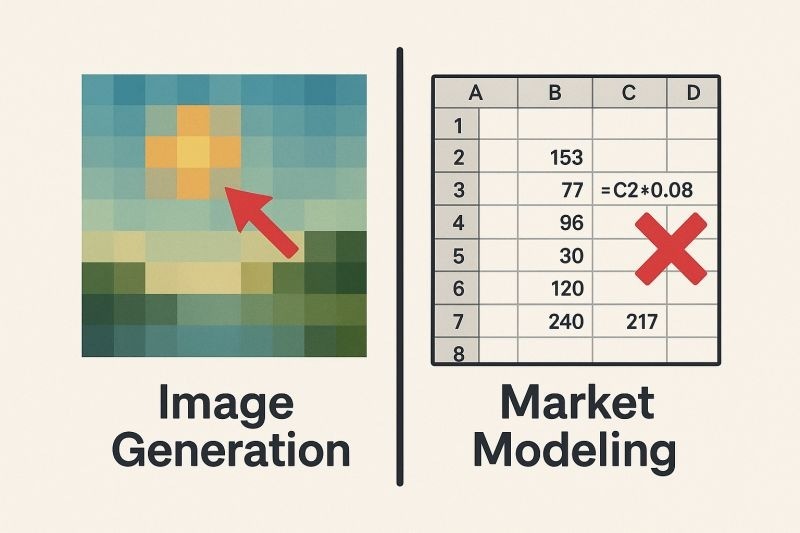
If you slightly change a pixel in an image, the image looks almost the same.
If you slightly change a formula in a market model, the entire model becomes useless ... or worse, dangerous, because you might believe it’s correct.
This, in my view, is the key reason why general-purpose AI systems can generate beautiful images and videos but fail to generate reliable market models in Excel.
Some people might argue: “GPT-5 only makes one mistake every 100 formulas. GPT-6, with more data, will make one every 10,000. It is just a matter of time.”
That is ACTUALLY WORSE.
Unless you can guarantee that the model is 100% correct every single time, the closer you get to perfection, the more dangerous it becomes. Instead of discarding it, users start trusting it, using it, and drawing wrong conclusions from it.
Who would make a multi-billion-dollar decision based on a massive Excel model where a single reference, one column off in a supporting tab, breaks the logic?
And if we must manually verify every formula, then what was the point of using AI in the first place?
Even if big players like OpenAI or Anthropic invest heavily in cleaner data and better training for generative AI in finance, the same recipes that worked for image and video generation WILL FAIL here. Unless they change the recipe, this battle is lost before it even starts.
🧠 The technical reason
From a technical standpoint, the utility landscape of images is smooth: small pixel changes lead to small changes in utility.
For financial and market models, that landscape is highly discontinuous: a small change in a spreadsheet can drop the utility to zero ... or even make it negative.
🔧 How do we solve this?
The AI agent should NOT operate directly in Excel space. It should work in a domain-specific, verifiable intermediate representation (latent space) that I like to call the Sufficient Workflow Representation (SWR). Importantly, one has to show the existence of a bijection between the space of SWRs and the space of valid models in Excel.
The AI agent operates in this latent SWR space and then programmatically maps its output into valid Excel models through this bijection. By design, it becomes IMPOSSIBLE to hallucinate and produce a model that is “almost right.” You only move between valid solutions. By contrast, no matter how well we prompt general-purpose AI, its generation mechanism fundamentally lacks awareness of the target workflow's structure.
Through an SWR is how AI becomes not just a writer of spreadsheets, but an expert in the workflows that shape real-world decisions ... and this is precisely why Lio by Aqmen AI can score 10/10 while big players struggle to build robust market models
(see my previous post here).
Written by:
Santiago Segarra
Co-founder and CTO
Share with friends:
Index